IRCC Project Begins Mangrove Restoration Training as a Nature-Based Solution to Climate Change

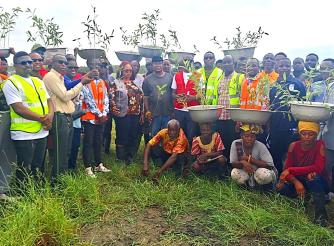
Partners implementing the Improved Resilience of Coastal Communities (IRCC) Project in Ghana, led by sub-implementing organisation ActionAid Ghana, have intensified climate adaptation efforts along Ghana’s coastline by training 250 residents in mangrove restoration to address escalating coastal erosion and safeguard vulnerable livelihoods.
The intervention, currently underway in the Anloga and Ada East and West Districts across the Volta and Greater Accra Regions, is being implemented with funding support from the Adaptation Fund as part of broader efforts to strengthen community resilience through nature-based solutions.
Delivered in collaboration with technical experts from Wildlife and Human Resource Management (WHRO), led by Dr. Andrew Agyekumhene, the training is equipping participants from eleven(11) coastal communities with practical skills in mangrove ecology, species identification, propagule and seed collection, nursery establishment, site selection, transplantation, monitoring, and sustainable mangrove management practices.
Addressing participants during the training, Dr. Andrew Agyekumhene encouraged community members to take ownership of the project to ensure its long-term success and sustainability.
“The IRCC Project is specifically designed to support the people of the Anloga and Ada coastal communities. It is therefore important for community members to protect and sustain the interventions to achieve maximum impact for present and future generations,” he stated.
The hands-on training is expected to strengthen local capacity for ecosystem restoration while improving adaptive resilience, biodiversity conservation, and sustainable livelihood opportunities for indigenous coastal populations.
The initiative comes at a critical time as Ghana’s coastal communities continue to face increasing climate-induced threats, including shoreline erosion, flooding, biodiversity loss, saline intrusion, and declining fisheries productivity. These impacts disproportionately affect women, youth, and small-scale fishers whose livelihoods depend heavily on healthy coastal ecosystems.
Mangroves are globally recognised as one of the most effective and low-cost nature-based solutions for climate adaptation and mitigation. They help stabilise shorelines, reduce the impact of tidal waves and flooding, sequester carbon, support biodiversity, and provide breeding grounds for fish and other marine species.
Under the IRCC Project, ActionAid Ghana and partners are targeting the restoration of 411 hectares of degraded mangrove ecosystems across project communities. So far, 15 hectares have already been restored through active community participation, demonstrating growing local ownership and early signs of ecological recovery.
Speaking during the training session, the Head of Programmes, Campaigns and Innovation at ActionAid Ghana, Justin Cyprian Bayor Esq., reaffirmed the organisation’s commitment to advancing locally led climate action and sustainable development.
“Our approach is anchored in strengthening the agency, skills, and leadership of communities to drive their own resilience-building processes. This intervention goes beyond ecosystem restoration; it is about securing livelihoods, advancing climate justice, and contributing to inclusive green economic transformation for coastal populations,” he said.
He further noted that the IRCC Project aligns with ActionAid Ghana’s Country Strategy Paper and Strategic Priority One on promoting a green economy and resilient livelihoods, while strengthening community ownership and ensuring the sustainability of climate adaptation investments.
ActionAid Ghana and its partners reiterated their commitment to scaling up evidence-based, community-driven, and nature-positive solutions through strengthened multi-stakeholder collaboration as Ghana accelerates efforts to respond to the growing impacts of climate change along its coastline.
Written by Jacqueline Parditey.